
.png?width=1326&height=405&name=EMPALogo_final_white-01%20(1).png)

📌 EMPA Short Take:
Most mistakes energy healers make when shopping for insurance come down to choosing a policy before fully understanding what it covers. Before making a decision, verify that your modalities are included, understand the policy language, compare more than just the price, and choose a provider that offers the guidance and support your practice may need as it grows.
Is your professional and general liability insurance policy aligned with the kind of work you’re doing?
What should you look for when choosing liability insurance for your energy healing practice?
Many practitioners may feel a little foggy at this stage. You want to be covered, you want to be responsible, and you want to make sure you’re getting good value for the investment you’re making in insurance coverage for your practice. Many policies can look similar on the surface; it’s not always obvious what is applicable to you, and what is not.
This is where mistakes tend to happen. Because key details are easy to overlook when you’re comparing energy healer insurance options, trying to balance cost, coverage, and simplicity. Not to mention, insurance coverage language is often not straightforward.
In this article, you’ll see the most common mistakes practitioners make when shopping for liability insurance, and what to watch for so your decision is informed, and you know you’re getting the best fit for your healing practice.
 Mistake #1: Not Getting Insurance at All for Your Healing Practice
Some practitioners move forward without liability insurance for their energy healing practice.
Not out of neglect; but because nothing has gone wrong. Your clients trust you. Your sessions feel personal. It can be easy to view protection as unnecessary.
This might be the most common (and most costly) mistake on our list!
Even in the most professional, ethical practices, accidents or misunderstandings can – and do – happen. A client may interpret an experience negatively, or have unrealistic expectations about the outcome of a session. Situations can arise that are outside of your control.
Without insurance, you’re handling those moments on your own. That can include managing complaints, navigating legal concerns, and covering any associated costs—both financially and energetically.
Choosing to wait—or move forward without professional and general liability insurance —means accepting that if something does happen, you’ll be handling it on your own. Before making that decision, take a moment to be honest with yourself:
- If something unexpected happened, would I be prepared to handle it on my own?
- Am I relying on past experiences instead of planning for future risk?
- If a situation escalates, do I have the time, energy, and financial capacity to manage it myself?
- Am I willing to risk the reputation I’ve built or the stability of my practice altogether?
Insurance may not be a ‘fun’ topic; it can feel foreboding. However, having coverage doesn’t mean expecting something to go wrong. It means being prepared if an unexpected situation arises.

Mistake #2: Are You Choosing Liability Insurance Based Only on Price?
It’s natural to look at cost first when comparing insurance for your practice. You’re running a business. You want something affordable and easy to move forward with. That makes sense!
The mistake is making price your deciding factor before you understand what you actually need from a policy.
Before comparing prices, decide what matters to you. Consider:
- The modalities you need covered, including every technique you offer professionally
- How and where you work, such as in person from your home or office, remotely, with groups, or through classes and workshops
- Coverage limits, including whether the policy provides the $2 million per occurrence and $4 million aggregate coverage (or more)
- Whether coverage is occurrence-based or claims-made, and what that means for you if you change providers, take a break, or stop practicing
- Any additional protections you need, such as coverage for business property, cyber incidents, or sexual abuse and misconduct claims
- Whether business-building resources, practice management tools, or ongoing education are valuable to you
Once you know your priorities, you can compare what each policy provides against what it costs. A lower-priced policy may meet everything you need, or you may find that it leaves out a type or level of coverage you want, or something that could give you a leg up as you’re building your practice. A higher-priced option may include additional coverage or benefits that you decide are worth paying for.
The good news is that energy healer insurance is typically affordable, with most plans ranging from $150-$400 per year. Prices can vary based on the types and levels of coverage, services covered, and additional benefits included.
Price is part of the comparison. Value comes from understanding what’s included and whether it fits what you need.
💡Have more questions about price? Check out our article: What Does Liability Insurance Cost for Healers and Holistic Practitioners?

Mistake #3: Does Insurance Cover All Energy Healing Modalities?
Many policies can appear similar at a glance, which can make it difficult to see meaningful differences between them. It can seem like as long as you have professional liability insurance to some capacity, you’re covered across the board.
In reality, that’s usually not the case.
What does "covered" actually mean?
- Your modality/modalities are listed as approved or eligible services
- It's included in the actual policy or program documents (not just marketing materials)
- It isn't listed as excluded elsewhere in the policy
- It's covered in the way you actually practice, whether that's in person, remotely, in group settings, or while teaching classes or workshops
Most standard liability policies are not designed with energy healing practices in mind. Many are built for general small businesses, or broader categories of work, including scopes like beauty or contracting work. That can create a disconnect between how you practice and how your work is defined within the policy.
💡During one of EMPA's new member meetings, two practitioners shared that they'd switched providers after realizing their policies didn't cover all of their modalities. One discovered her Spiritual Healing work wasn't covered; the other that her Medical Intuition work wasn't.
Neither policy looked incomplete on paper — both used broad language like "wellness" and "holistic health services." Broad language doesn't guarantee every modality you practice is named and covered. If one of yours is not, you may not find out until you need to file a claim.
If your modalities aren’t clearly recognized, or if your work is interpreted differently than you expect, you may find yourself without the level of coverage you thought you had.
You might take these questions into consideration:
- Is my modality clearly included in this policy?
- How does the provider define the work that I do?
- Is the way I practice covered, including remote sessions, group work, classes, or workshops?
- Does this provider specialize in energy healing and holistic practices, or serve a broader range of industries?
The more aligned the policy is with your practice, the more confidence you’ll have in how it supports you.

Mistake #4: Are You Buying a Policy Without Understanding the Language?
Liability insurance policies aren’t always written in a way that feels clear or intuitive.
Even when your practice is included, the wording around coverage can be easy to misinterpret.
Certain terms, conditions, and phrasing shape how your liability insurance responds in a real situation. Similar to what was mentioned in mistake #2, if language isn’t fully understood, it’s easy to feel that you’re covered in ways that may not hold up.
Here are some helpful questions to guide through confusing terminology:
- Does this actually make sense to me, or am I just guessing what it means?
- Am I skimming past words because they feel overly complicated or unclear?
- If I had to explain this to someone else, could I—or would I be stuck?
A good place to start is by checking the policy’s FAQ page to see how things are explained in plain terms. You can also learn a lot by asking others in your space or getting real feedback from practitioners with similar work.
If something still doesn’t feel clear, try reaching out! If you have questions, look for a provider that's accessible and willing to explain coverage in simple, digestible language.

Mistake #5: Overlooking Education and Resources for Energy Healers
Purchasing insurance is only one part of protecting your practice. Whether you’re brand new or as your business grows, you'll likely have questions about documentation, ethics, risk management, marketing, or regulations. Some providers simply issue a policy, while others continue supporting you with education and resources long after you've enrolled.
That’s an important distinction to consider when choosing where to get your coverage.
Insurance protects your practice when something goes wrong. A professional association can also provide education and resources you can use as you build and run your practice.
As your practice evolves, new layers of responsibility and decision-making naturally come with it. Without access to the right information, you’re left to figure those pieces out on your own.
Education is part of the foundation, not an extra ‘bonus.’ Depending on where you choose to be insured, keep an eye out for helpful resources:
- Risk management strategies to help you prevent issues before they arise
- Marketing education to help you share your work clearly and ethically
- Insight into laws and regulations that may impact your work
- Tools to help you structure and grow your business
- Client paperwork templates to create consistency and professionalism
- Resources you can share directly with your clients
- Access to training, courses, and events relevant to your work
This is why many small businesses naturally gravitate toward specialized associations that align with their industry—whether that’s writers, tradespeople, independent beauty professionals, or energy healers and holistic practitioners.
Having coverage is important. Having the knowledge, tools, and resources to run your practice well is what makes the difference long term!

Mistake #6: Are You Assuming Homeowner’s Insurance Covers Your Healing Practice?
Some practitioners assume their homeowner’s or renter’s insurance policy will automatically protect them if something during a client session in their home office.
In most cases, that is not how those policies are designed to work.
Homeowner’s insurance is typically written to protect personal residential risks — not professional business activities, client interactions, or services provided for income.
So, if you’re operating in your own home, whether you’re:
- Seeing clients in person
- Offering paid remote sessions
- Running virtual workshops
- Providing other paid professional services from your home
…it’s important not to assume your homeowner’s policy extends to those activities.
A separate professional and general liability policy can provide coverage for your professional work that a homeowner’s or renter’s policy typically isn’t designed to provide. The goal is to make sure your practice activities are intentionally recognized and protected, rather than relying on personal insurance that may not apply to business-related situations.

Mistake #7: Are You Choosing a Policy Before Getting All Your Questions Answered?
When you’re shopping for insurance, you may be eager to get covered, move forward, and check it off your list.
Rushing into a policy before you fully understand what you’re purchasing can lead to confusion later on.
A trustworthy provider should be willing to answer your questions clearly and give you space to make an informed decision. You should feel comfortable asking:
-
What exactly is covered?
-
What’s excluded?
-
Are all of my modalities included?
-
Is the policy claims-made or occurrence-based?
-
Who is the underwriter? What is their AM Best rating?
-
Is there anything in the policy I don’t understand?
If a provider makes it difficult to get straightforward answers, that can be useful information in itself! While coverage is better to have sooner rather than later, the goal for comprehensive coverage for a modern practice is usually not to make the fastest decision possible. Instead the attention should be directed towards choosing coverage that genuinely fits your practice and helps you feel supported moving forward.
💡Thinking beyond insurance is just as important as choosing it. Download your free guide: The 3 Biggest Mistakes Energy Healers Make—and How to Avoid Them to strengthen how you practice every day.
 Choosing Coverage With a Clearer Understanding of What You Need
Knowing the common mistakes practitioners make when shopping for insurance can help you avoid them in your own search. You now know where to slow down, what details deserve a closer look, and what questions to ask before choosing coverage for your practice.
You don’t have to know everything about professional liability insurance to avoid these mistakes. You just need to know what matters for your practice, what to verify, and when to ask for clarification.
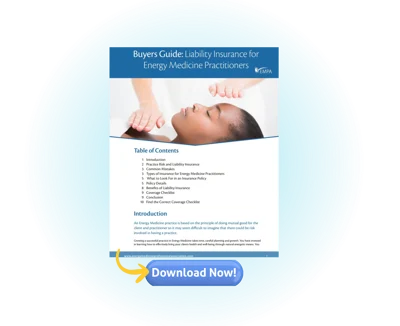
Want some extra guidance as you shop for insurance? Download our free Buyer’s Guide: Liability Insurance for Energy Medicine Practitioners to help you identify what to look for and what to consider along the way.

 Frequently Asked Questions
When should I get professional liability insurance for my energy healing practice?
It is wise to have coverage in place prior to working with the public. Complaints, misunderstandings, and accidents can happen even when your practice is new or part-time. Professional and general liability insurance is designed to protect you before an unexpected complaint, accident, or legal issue arises.
Does my homeowner’s or renter’s insurance cover my healing practice?
Usually, personal home insurance is not designed to cover paid services, business activities, or client interactions. Ask your insurer directly rather than assuming work you do in your home is included.
How can I tell whether all my healing modalities are covered?
Review the provider’s list of covered services and confirm every modality you offer. A broad label such as “wellness” or “holistic services” does not always include all forms of energy or holistic healing.
Can one policy cover me if I practice several modalities?
It may, but the answer depends on the policy. Give the provider a complete list of your services and ask for confirmation that each one is eligible for coverage before you enroll.
Are remote healing sessions covered by professional liability insurance?
Some policies cover both remote and in-person services, while others may have limits or exclusions on remote sessions. Confirm how your virtual sessions are classified and whether they are included before purchasing coverage.
What should I do if I cannot understand the policy language?
Ask the provider to explain the terms, exclusions, and limits in plain language. You should be comfortable with what you are purchasing before you commit.
What questions should I ask an insurance provider before choosing a policy?
Ask what types of coverage are included and what the coverage limits are, whether all your modalities are covered, what exclusions apply, whether the policy is occurrence-based or claims-made, who underwrites it, and what help is available if a complaint or claim arises.
Disclaimer: This article is for educational purposes only and does not provide legal, financial, or medical advice. The examples are general, and coverage may vary by policy. Always refer to your insurance provider or policy language for specific details, as the policy terms take precedence. For legal concerns related to your practice, consult an attorney.
Topics: