

Shopping when you don’t know what you’re looking for is one of the worst kinds of shopping.
It’s like wandering the aisles of a grocery store on an empty stomach; everything looks good, and you end up with five sauces, no actual meal, indecision, and a sense of regret before you’ve even checked out.
Or trying to buy a loved one a birthday gift for someone with no clear idea of what they want (or need).
Or shopping for a special event outfit, and after several dressing rooms, nothing feels quite right, and you’re ready to throw in the towel.
Now imagine the frustration of all these scenarios bundled up into one experience.
That’s what shopping for liability insurance can feel like.
You're trying to protect your practice. You're being responsible. Though sometimes, instead of feeling clear and confident, you're stuck between tabs, terms, and policies that all sound kind of the same..and yet…different?
Don’t worry, we’re here to help!
Yes, we know that insurance shopping can be tedious and frustrating…but it doesn’t have to be. Once you know what you’re looking for, the process actually gets simple. Let’s get started!
 Your Core Coverage
Before you compare prices, providers, or policy details, you need to know what you’re actually shopping for.
For energy healers, your starting point will typically be a policy that includes both professional liability and general liability insurance. These two coverages form the foundation of protection for your practice. From there, you will ideally want to seek a policy that builds in additional protection for you and your clients; for now, let's focus on the core:
- Professional liability protects you if someone claims your healing work caused harm, distress, or didn’t meet expectations.
- General liability protects you if someone is physically injured or their property is damaged during a session, even if the injury happens just walking up to your door.
Together, these cover the most common risks practitioners face. It doesn’t matter if you only see clients online, only work on friends and family, or are still in school. If you’re offering your services, even casually, you’re taking on risk.
For example, one of our members was named in a lawsuit after someone slipped on ice outside the event venue - despite the fact that she was only there as a guest speaker!
In 20+ years of working with this community, we’ve seen that for most healers, professional and general liability policy form the foundation of a well-protected practice - often as part of a more comprehensive policy that supports the full scope of their work.
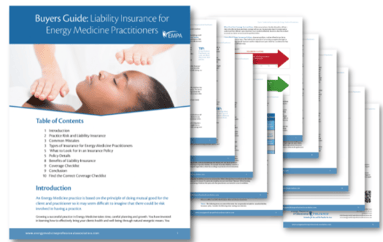
Your comprehensive protection starts here. Learn more with EMPA’s free Buyer’s Guide for energy and holistic healers!
 Other Forms of Coverage You May Consider
While general and professional liability are the essentials, some practitioners may want additional protection depending on how they work.
If you have employees, sell products that you make, or host events, you might consider additional coverage options like product liability, property insurance, or event-specific policies. These aren’t required for every healer, but it’s good to know they exist in case you ever need them!
 What You Probably Don’t Need
Some insurance terms are thrown around as if they’re applicable to everyone and anyone, but aren’t actually relevant to most energy healers.
For example, medical malpractice insurance is intended for licensed medical professionals. Unless you hold a license in a healthcare field, you don’t need it (and wouldn’t qualify for it anyway).
Similarly, errors and omissions (E&O) insurance is designed for professionals like real estate agents or financial advisors. If you’re seeing E&O mentioned as a selling point, it’s a sign that the policy probably isn’t tailored to your work.
Not every type of insurance applies to energy healers. See how malpractice, E&O, and professional liability differ in our article: Energy Healers Insurance Guide—Understanding E&O, Medical Malpractice, and Professional Liability Coverage.
 Shop Smart: What to Look for in a Policy
Now that you know what you need, the next step is choosing a policy that actually covers what you do. Here is a checklist you may consider as guide as you do your research:
 Bundled Coverage: Look for a policy that includes both professional and general liability together, as these are commonly combined for simplicity and consistency. Many practitioners find this works best as part of a broader coverage structure.
Modality Coverage: Make sure the policy clearly includes the specific modalities you practice. You should never assume something is covered just because it’s “energy work.” If your modality isn’t listed or confirmed, you might be paying for insurance that doesn’t actually apply to your sessions.
Check out EMPA’s list of pre-approved energy healing modalities here. Don’t see yours listed? Contact us to ask!
Exclusions: Read the fine print. Some policies exclude higher-risk services or settings, and others may leave out even common practices within your work – like group sessions, teaching, or remote work.
Claims-Made vs. Occurrence-Based: This determines how and when you're covered. With occurrence-based policies (like EMPA’s), you may be protected if a claim comes in after your policy ends, as long as the incident happened while your coverage was active.
Wondering what “claims-made” and “occurrence-based” really mean? These terms impact how and when you’re protected—so it’s worth understanding the difference. Read: Understanding Coverage: Claims Made and Occurrence Insurance
Coverage Limits: Look for limits that match your risk. $2 million per claim and $4 million total per year is a common, reliable standard in our field.
Added Benefits: Check for what else might be included. If you’re buying from a generic insurance company, you’re probably just getting a policy. But if you’re buying through a professional association like EMPA, there may be other things that go along with your membership – like courses, trainings, form templates, and community support!
What’s Next: Use the Buyer’s Guide Built Just for You
You don’t have to guess. You don’t have to sort through generic policies that barely speak to what you do. You have a resource made specifically for energy healers.
EMPA’s free Buyer’s Guide was created to walk you through this process with clarity and confidence—from understanding the coverage you need, to comparing real options, to choosing a policy that actually fits your work.
If you’re serious about protecting your practice, this is the place to start.
Get the Buyer’s Guide and shop smarter, not harder!
Disclaimer: This article is for educational purposes only and does not provide legal, financial, or medical advice. The examples are general, and coverage may vary by policy. Always refer to your insurance provider or policy language for specific details, as the policy terms take precedence. For legal concerns related to your practice, consult an attorney.
Topics: